
How early should you start planning your MSP exit?
As early as possible, and whether or not you plan to sell. Every MSP owner needs a succession plan, whether that means selling to a third party, a management buyout (MBO), or handing the business to family. I have led more than 15 acquisitions, and the founders who exit best share one habit: they run their business as if they were going to sell tomorrow.
If you do want to sell, about 24 months is the right runway to fix the gaps a buyer will find. But the habits that make a business easy to sell are simply good practice, so there is no good reason to wait.
- Every owner needs a succession plan, whichever route they choose: third-party sale, MBO or family.
- The best exits come from owners who run the business as if they were selling tomorrow.
- Buyers pay for predictability, not effort: contracted recurring revenue, a spread of customers, and a business that runs without you.
Why do buyers pay for predictability, not effort?
A founder can work seventy-hour weeks for a decade and still sell at a modest price if the revenue is month-to-month, one customer pays a big share of the bills, and every key relationship runs through the owner. A buyer is not paying for how hard you worked. They are paying for how confidently they can predict next year's income.
The strongest thing a founder has ever said to me was: "Without me, I can go away for two months. Nothing's going to change." That sentence is worth a lot to a buyer, but only if it is true. It usually takes time to de-risk yourself from the business to that level, so the earlier you start, the better.
How do buyers value an MSP?
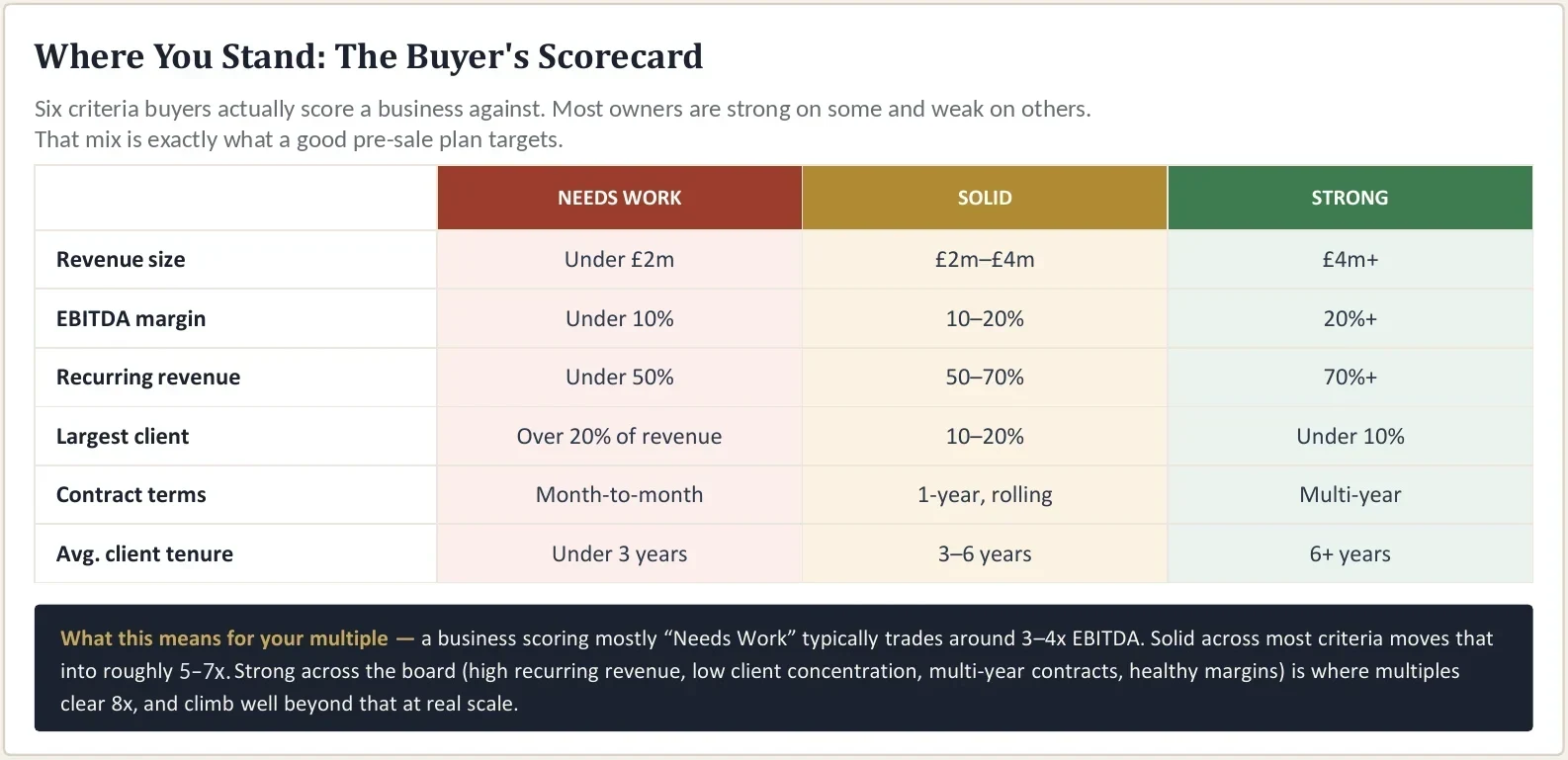
There is more than one way to value an MSP, and every buyer has its own model. The market standard today is to value an MSP as a multiple of its adjusted EBITDA (in plain terms, its underlying annual profit). That multiple depends first on the size of the business, and then on the quality of its revenue. Every buyer weighs things differently, but the criteria below are the ones nearly everybody looks at when buying a business.
View the scorecard as text
| Criterion | Needs work | Solid | Strong |
|---|---|---|---|
| Revenue size | Under £2m | £2m to £4m | £4m+ |
| EBITDA margin | Under 10% | 10% to 20% | 20%+ |
| Recurring revenue | Under 50% | 50% to 70% | 70%+ |
| Largest client | Over 20% of revenue | 10% to 20% | Under 10% |
| Contract terms | Month-to-month | 1-year, rolling | Multi-year |
| Average client tenure | Under 3 years | 3 to 6 years | 6+ years |
As a rough guide, a business that scores mostly "needs work" trades around 3 to 4 times EBITDA. Solid across most criteria moves that to roughly 5 to 7 times, and strong across the board is where multiples clear 8 times. Size counts first, but the other criteria decide where in the range you land. These ranges are indicative, based on our own experience, and are not a valuation.
Want the full scorecard, the readiness test and the fixes in one working checklist?
Get the checklistWhat should you prioritise before starting an exit process?
Think in terms of priority rather than a countdown. If you do these three things in order, you will be ready whenever the right moment arrives.
1. Decide why, what, when and how much
Start with the reason. Why do you want to exit: retirement, a new chapter, or because the business needs capital to grow? Then what kind of exit suits you: a full sale, selling a majority and staying on, an MBO, or passing it on to family. Think about what kind of buyer you want, because buyers value different things. A founder-owned acquirer, a private equity backed platform and a permanent-capital buyer like Kingsgate will each offer something different.
Then decide when. Many people work towards a goal, such as an age, a number or a life event. Be honest about the gap between that number and what your business is worth today. Talking to owners who have already sold, and to buyers directly, is the quickest way to calibrate it.
2. Clean up the numbers so a stranger can understand your business
Make your business easy for a third party to read: keep recurring revenue separate from one-off projects. Keep your accounts consistent, and be able to explain in plain terms every adjustment you make to your profit. It also shows you the gaps. You may find recurring revenue is slipping, or that too much of your income sits with your top five customers. Once you can see the risks, you can reduce them and optimise the value of your business.
Report your revenue on an accrual basis: record income in the period you deliver the service, not when the cash arrives. If a customer pays for a year upfront, only a twelfth belongs in each month. Buyers value you on recurring income, and cash-basis figures make annual prepayments look like windfalls and quiet months look weak, which makes your accounts hard to trust.
3. De-risk the business from you, from day one
This is not something to leave to the last six months. It is a philosophy. Take yourself out of the critical path as early as you can: hire the right people, pass on your knowledge and your key customer relationships, and write down how the business runs. Bring in an accountant and a lawyer early, and choose ones who understand the MSP industry.
This pays off in two ways. First, the fewer key responsibilities sit with you, the easier and cheaper you are to replace, and the transition can be smooth, easy and short. Second, there is no longer any risk in losing you, because no customer relationship or technical expertise leaves with you. That is exactly what a buyer wants to see.
Should you talk to buyers who approach you?
Yes, selectively. It is always healthy to have conversations with buyers, long before you plan to sell. They help you understand the spectrum of buyers out there, which ones have a model that fits your philosophy and goals, and which ones you actually get on with. They can also tell you what to improve or change in your business to earn a better valuation. Think of it as part of your own due diligence on whoever will have the privilege of inheriting what you have spent many years to build.
You are probably approached by buyers every week, and you should not talk to all of them as it can be disruptive to the business. Filter instead: reply, ask a few questions about their acquisition model, their funding, their typical deal structure and what happens to the team and to you afterwards, and only speak to the ones who answer well.
The aim is to constitute yourself a shortlist: a handful of buyers whose model is aligned with your goal and whose people you trust. Build those relationships over time, so that when a future exit becomes concrete you are talking to people you already know. The checklist includes the full set of screening questions and a ready-to-send email.
How ready is your MSP?
Answer 14 short questions to find out your level of readiness, with practical advice on what to work on first. It takes about three minutes.
Start the MSP exit readiness quizGet the MSP Exit Readiness Checklist
This article shows you where buyers look. The checklist is the work plan: the step-by-step roadmap, the ten-question readiness test, what kills deals and how to fix it, and a template for screening buyer approaches. Enter your name and email and we will take you straight to the download.
About Kingsgate
Kingsgate is a permanent home for established managed IT (MSP) businesses across the UK and Ireland. Unlike traditional private equity, we buy to hold forever, preserving each company's team, brand and culture while investing in its growth. Founders can build alongside us or hand over leadership, on their own terms. Read more about how we work and who we are.
If you are thinking about the future of your MSP, whether you are two years from a sale or simply want to understand how a buyer would see your business, we are happy to have a confidential, no-obligation conversation. Get in touch with the Kingsgate team.
This article is educational material for MSP owners and is not financial or legal advice.